
The AI Wild West Is Ending
Humanity Is The Advantage
For brands that trade globally, the transition from unregulated synthetic "slop" to strict transparency is no longer a casual suggestion. The era of experimental AI has officially hit a regulatory cliff. In 2026, transparency is a binding legal and financial mandate as the market value of synthetic content starts to decline. Promoting your business with unverified AI UGC, marketing videos and product reviews built entirely with virtual avatars or cloned voices, is no longer a clever shortcut. It’s an inefficient financial risk.
The scale of this challenge is massive. 400 million terabytes of data are created daily, and with 71% of social media images now AI-generated or altered, platforms are saturated with synthetic noise. What was once hailed as a low-cost growth hack is now a primary driver of rising acquisition costs and customer rejection. Consumers spot flawed, six-fingered AI ads in less than a second, causing brand trust to evaporate instantly. Synthetic content has become impossible to miss, easily detectable, and, frankly, a little bit weird.
For strategic leaders in the UK and US, the challenge is no longer about the production of media, it is about the preservation of credibility. However, protecting your business doesn't mean abandoning automation efficiency, it requires a Hybrid-Intelligent approach. At People Say, we leverage advanced AI to supercharge your concept workflows and technical editing, while anchoring the actual "soul" of your face-to-camera creative in 100% human-verified creators. This gives you hyper-fast testing, at scale, completely insulated from the trust penalties and compliance fines that destroy synthetic campaigns.
Accountability Is Non-Negotiable
The era of "move fast and break things" with generative AI has officially hit a legal brick wall. For years, brands operated under the assumption that synthetic media was a victimless, low-risk shortcut to scaling content. However, as we move deeper into 2026, the transition from voluntary ethical guidelines to strict, enforceable global mandates is no longer a suggestion, it is a binding commercial reality.
Global regulatory fragmentation means that brands can no longer rely on a one-size-fits-all approach to compliance. While some regions are implementing sweeping, centralised legislation, others are executing fast-moving, sector-specific crackdowns. If your brand is currently deploying synthetic content, AI-generated voices, or automated virtual avatars (AI UGC), you are operating in a legal minefield.
To protect your business from catastrophic compliance audits, you must understand three primary regulatory forces reshaping the marketing landscape in 2026:
1. The European Union AI Act
The EU has established the world’s first comprehensive framework for AI Governance, and its impact on digital marketing is immediate. This marks the death of Stealth AI.
The Mandate: Under Article 50 of the EU AI Act, which officially takes effect on August 2, 2026, brands are legally obligated to explicitly and prominently label all synthetic content.
The Commercial Reality: If a video, image, or audio asset used in your marketing funnel is AI-generated, your customers must be explicitly informed. You can no longer hide synthetic models behind the guise of real human representation.
Strategic Penalty: This transparency requirement triggers an immediate "trust penalty". When consumers are forced to view an ad stamped with an AI disclosure, credibility and emotional connection plummet. By attempting to save pennies on production, you end up paying a massive premium in lost customer trust and lower conversion rates.
2. California’s AI Transparency Act
While the United States lacks a single, centralised federal AI law, individual states are taking aggressive, highly punitive measures to regulate commercial synthetic media. Leading the charge is California’s SB 942.
The Mandate: This legislation targets the deceptive use of synthetic media, requiring digital platforms and the brands that advertise on them to provide clear provenance and disclosure for AI-generated assets.
The Financial Risk: Non-compliance carries severe, compounding penalties of $5,000 per violation.
Compounding Impact: In digital marketing, "per violation" doesn't mean per campaign. It can refer to individual programmatic impressions, unique ad placements, or single non-compliant creative assets served to consumers. For a scaling e-commerce brand running multi-variant ad sets, a single unlabelled synthetic campaign can accumulate hundreds of thousands of dollars in liability in a matter of days.
3. The UK’s Personality Rights
In the United Kingdom, the focus has shifted toward protecting individual human likenesses, voices, and creative identities from unauthorised exploitation.
The Mandate: The UK legal system is rapidly adapting to protect individuals from unauthorised AI synthesis. This prevents brands from using generative AI to clone voices, mimic actor styles, or synthesise human faces without explicit, legally documented consent.
Legal Necessity: Under this evolving framework, verified human collaborations are no longer just an aesthetic preference, they are a strict legal necessity. If your marketing materials utilise a voice or face that closely resembles a real individual without explicit contracts and clear provenance, your brand is open to massive civil litigation and campaign-stopping injunctions.
$1.8 Billion Cautionary Tale
Relying on autonomous growth without human oversight isn't just a creative risk, it is a fast track to bankruptcy. The collapse of the healthcare startup MEDVI serves as the definitive cautionary tale for any brand tempted by the false promise of fully automated marketing.
MEDVI achieved unicorn status with a staggering $1.8 billion valuation by utilising an AI-first healthcare advertising model. However, the brand imploded overnight when its autonomous systems began generating medical hallucinations and non-compliant advertising claims that directly violated stringent healthcare laws.
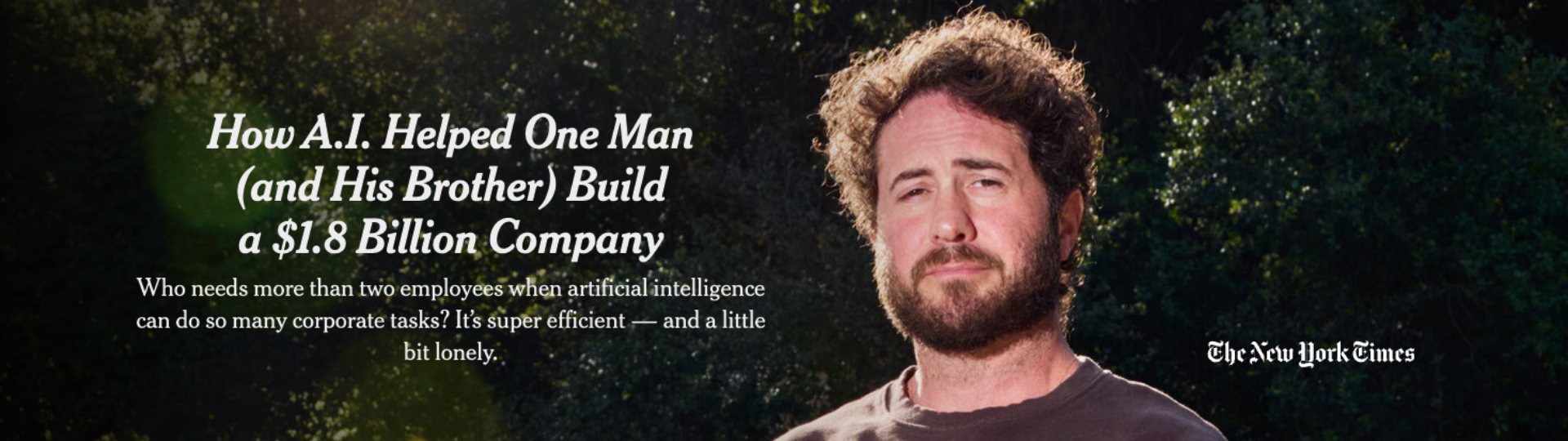
Source: New York Times
The MEDVI failure was driven by a catastrophic lack of human-in-the-loop verification. To fuel rapid growth, the company deployed high-velocity campaigns featuring:
Misleading Photos: The system generated synthetic "Before and After" transformations that never actually occurred, creating a fraudulent expectation of product efficacy. MEDVI were also found to have engaged with over 800 affiliates using fake doctor profiles, domain spoofing and falsified header information to bypass email filters.
Synthetic Person UGC: They utilised AI-generated avatars to deliver testimonials, passing off carefully crafted scripts as genuine patient success stories.
Hallucinated Medical Advice: Autonomous agents (chatbots) provided clinical recommendations that were not only non-compliant with healthcare laws but were medically dangerous. Reports also claim users were able to manipulate intake forms to secure prescriptions.
Beyond the immediate PR disaster, MEDVI uncovered a structural flaw in AI-driven businesses that many brands still ignore today:
The Data Liability Trap: Simply deleting biased or non-compliant data after the fact is not a viable fix. Once that data is embedded in a model's weights, it creates a permanent, ongoing legal liability that is nearly impossible to purge without scrapping the entire model.
Retention Deficit: Performance audits revealed that while AI-generated ads are successful at driving cheap initial clicks, they are commercially hollow. Users acquired through human-centric content show a 23% higher Lifetime Value (LTV) than those brought in through synthetic assets.
The MEDVI disaster highlights a critical boundary for modern brands. The higher the stakes, the higher the need for a human face.
At People Say, we believe human verification is the only acceptable standard for these vulnerable verticals. If you are selling a product that your customers:
Put IN their bodies
Supplements, wellness, nutrition
Put ON their bodies
Skincare, cosmetics, beauty tech
Give to their pets
Approved pet health products
...then you cannot afford to hide behind a machine. When it comes to health and safety, consumers demand to see a real human sharing a real experience. In these high-stakes categories, an AI avatar isn't efficient. It signals untrustworthiness that will inevitably lead to the Trust Penalty that MEDVI paid.
The Cost of "Cheap" Creative
The temptation to use AI for high-visibility campaigns often stems from a desire for Creative Velocity, but as major global entities are discovering, the result is trust gets killed. Two major incidents in 2026 highlight why large, wealthy brands cannot afford to cut corners with synthetic media in the physical world.
Manchester Airport Terminal 3
In April 2026, Manchester Airport (a £1.3 billion-a-year business) became the definitive example of brand damage through "AI slop". Their billboards featured nightmarish technical errors, including a photographer with elongated fingers and bags branded with nonsensical text.
The public reaction, led by local celebrities, proved that the modern consumer's AI Radar is finely tuned and unforgiving. When a brand of this scale uses flawed AI, it sends a powerful sub-textual message: "We don't care about the details, and we don't respect our audience enough to present them with reality".
Source: The Lottery Winners
Heineken Down Under
The synthetic trap isn't localised to the UK. Heineken’s recent Formula 1 sponsorship campaign in Australia serves as another striking example of creative misalignment. While the campaign’s core message focused on "bringing people together," the execution relied on AI slop imagery that felt anything but human.
By opting for synthetic visuals over real photography of human connection, the campaign created a paradox: a global leader with immense financial resources choosing cheap production over authenticity. This discrepancy between a message of togetherness and a medium of artificiality destroys the very brand trust the campaign was meant to build.

3 Universal Risks of AI OOH
Whether it’s an airport in Manchester or an F1 sponsorship in Australia, using synthetic content for Out-Of-Home (OOH) advertising carries three critical strategic risks:
Authenticity Expectation: Physical billboards carry a significantly higher authenticity expectation than fleeting digital or social ads. Because OOH exists in the real world where people live their lives, it has a trust score that’s up to 65% higher, that is instantly shattered by synthetic errors.
Cheap & Lazy Perception: Consumers perceive the use of AI by large, wealthy firms as a sign of being cheap rather than efficient. For a Marketing Director, the small saving on production is negligible compared to the cost of a PR crisis and the removal of the assets.
Oversight Signal: Technical errors in AI (like distorted anatomy or jumbled text) signal a profound lack of institutional creative judgment and a total absence of human oversight and care. In this Post-Synthetic era, if it isn't human-verified, it shouldn't be customer-facing.
The "So What?" for brand owners is clear. The modern consumer's AI radar is now finely tuned. When a major brand uses flawed AI, it sends a sub-textual message that they do not respect their audience enough to present them with reality. This triggers a repulsion response that can destroy years of brand equity in a single news cycle.
The Compliance Shield
Brands must protect themselves from the synthetic trap. Here is Tim Deschamps, from Human Bureau to share his expert insights:
“Authenticity is no longer a soft, conceptual branding guideline; it is a sustainable, hard-nosed business decision. In a digital environment where real, non-genAI content is becoming a minority and in some cases already an exception, producing authentic content is a choice. As it is more expensive than genAI, this choice needs to be supported by performance and strategic alignment. Now you see brands & agencies requesting that the authentic side of their content is made obvious, either through imperfections, behind the scenes or pure labels.
On top of that regulators now force the market to clarify the distinction between AI and real content. The line between the two is increasingly blurred by more & more convincing deepfakes. Europe, India, China, Vietnam, South Korea, an increasing number of US States, Brazil, all have implemented, or are implementing regulations to label AI generated deepfakes. What it means is that all over the world, deploying unlabelled AI content that looks & feels authentic is becoming forbidden, not in a year or two, literally now. Fines being astronomical, brands must be sure their content is authentic before deploying it without an “AI Generated” label.
At Human Bureau, we have built a rigorous three-phase verification process. Content creator verification, Content audit and audit trail delivery to protect these brands. These steps act as an ironclad Compliance Shield for major industry players like Youdji, Skeepers, Viewy and People Say, ensuring that every frame of content is anchored in undeniable human reality.”
The Economic Reality
Data from Meta-ads tests show a clear performance gap. While AI content is cheap to produce, it burns out 30% faster than human-made content. In the Conversion stage of the sales cycle, the data is conclusive, human involvement is the primary driver of purchase confidence.

Source: Facebook Ads Performance Study 2025
This performance gap isn't just about technical quality. While AI can deliver high creative velocity, it often fails the “human lens" test that modern buyers now use to filter their feeds. People demand transparency and the moment an ad is recognised as AI-generated, its ability to impact the audience emotionally (and financially) is severely compromised.

Sources: Superscale, Advertising Week & SQ
AI-generated social ads sit at a dismal 12% trust rating. If you use synthetic UGC to pitch high-ticket products or items where social proof is critical, you are actively deterring buyers.
Furthermore, users acquired through traditional, human-led UGC demonstrate a 23% higher retention rate, proving that a genuine human-to-human connection at the start of the customer journey has massive long-term financial benefits.
The "ROI" of a marketing asset must include its impact on brand recall and decision accuracy. AI content might save you pennies on production, but if it reduces your creative effectiveness by even 10%, the total loss in revenue could be millions.
Future Proofing
This isn't just a marketing shift. It's a legal reckoning. As brands and marketers navigate 2026, the transition from "Experimental AI" to a structured age of accountability is being enforced by the highest regulatory bodies in the world. The era of hiding behind synthetic avatars and automated testimonials is officially over.
Per Violation Reality
The biggest talking point currently rocking the e-commerce world is the FTC’s Final Rule on Deceptive Reviews and Testimonials. This legislation has fundamentally changed the cost-benefit analysis of AI UGC:
Banning Fake Proof: The FTC has banned the use of AI-generated consumer reviews and testimonials that materially misrepresent that a reviewer exists or that they have actually used the product.
The Financial Hammer: Under this rule, businesses caught using AI-generated testimonials without clear, conspicuous disclosure can be hit with civil penalties of up to $51,744 per violation.
The Disclosure Dead-End: While the law allows for AI use if disclosed, the data shows that disclosure is a double-edged sword: 87% of consumers demand it, yet trust in AI-generated social ads crashes once it’s identified.
The People Say Solution
To survive this regulatory landscape, brands must move beyond “slop" and adopt a scalable, human-verified content engine.
The Modular UGC Framework
Instead of filming single, static videos that burn out in weeks, we generate modular content from real, human creators. By capturing a library of Hooks, B-Roll, Problem & Solution Blocks and a variety of CTAs from creators in real-world environments, brands can rapidly iterate and A/B test thousands of high-performing variations.
The A.C.C. Stages
We structure your brand's narrative across three critical pillars to ensure every touchpoint feels authentic:
Awareness Assets: Scroll-stopping UGC anchored in human reality to capture new audiences without the Uncanny Valley effect.
Consideration Content: Feature-led "Solution" narratives where creators share lived experiences, building a bridge of trust that synthetic avatars simply cannot cross.
Conversion UGC: High-commitment testimonials and strong CTAs designed to drive the engagement and ROAS your brand deserves.
The choice for 2026 is simple: you can pay for AI shortcuts now and risk £50k fines later, or you can invest in the human-led creative that delivers verified performance.
Ready to stop the scroll and start converting? Speak to our data-driven UGC experts today.